Building Trust In Government Communications
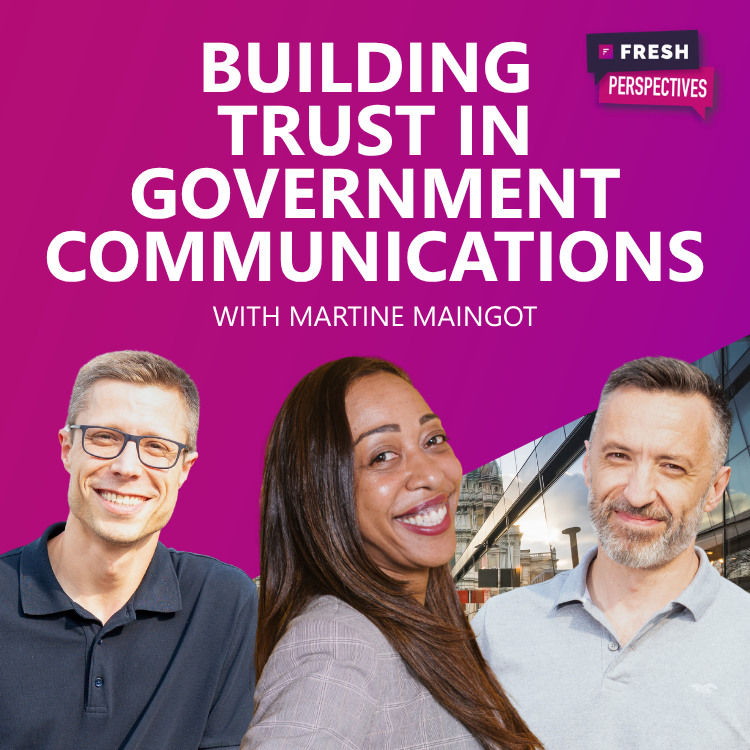
What does ownership look like when your audience is an entire city?
Martine Maingot leads centralised communications for the Equity and Inclusion Cabinet at the City of Boston; eight departments, six initiatives, around 80 people in the cabinet and roughly 18,000 across the city, communicating in twelve languages besides English. Asked what she owns, her answer is immediate: the connective tissue between the departments.
David Bowman and Jarbas Horst talk to Martine about how communications has changed since her first internship in 2004, when social media was blocked at work as a distraction. About the discipline of one message and seven touches, where the core claim stays fixed and only the format moves. About why word of mouth remains the most powerful channel there is, and why a message that takes a paragraph to explain will never travel.
The conversation also gets into the harder edges of the job: the question she asks herself before any difficult message goes out, why communicators are gatekeepers of the narrative, and exactly where she draws the line on AI.
Listen on your favourite podcast app



One message, seven touches: how the City of Boston communicates across eight departments
Ask most communications leaders what they own and you’ll get a list of channels. Ask Martine Maingot and you get something more useful: the connective tissue between the departments.
Martine leads centralized communications for the Equity and Inclusion Cabinet at the City of Boston, a cabinet made up of eight departments and six initiatives, with around 80 people working in it and roughly 18,000 across the city as a whole. Boston is a city where twelve languages besides English are spoken, and where the mission, as she describes it, isn’t just to let people live there but to help them thrive.
That combination, high stakes, low default trust, an audience that cannot opt out — makes it a useful place to look at what ownership of communications actually demands.
One message, seven touches
The framework Martine works to is deceptively simple. Seven touches across channels, carrying one message.
The discipline is in holding the core claim constant while letting the format of the channel vary. A flyer, a caption, a talking point and a conversation can each deliver the same claim without delivering identical words. What they can’t do is drift into seven separate messages, which is what happens when each channel is treated as a fresh creative brief.
There’s an important exception to consistency, though. For word of mouth, Martine actively wants people using their own words. If everyone recites the same script, the message stops reinforcing and starts signaling that it was handed down and, as she puts it, people know when you’re not being authentic.
Why word of mouth still wins
Martine describes a cartoon advert that stuck with her. A cherry Coke appears on a billboard, on a flyer, in someone’s hand in the street; every touch point a marketer would plan for. Then the final panel shows two friends dining al fresco, one asking the other whether they’ve tried it.
That’s the frame that works, because word of mouth carries trust that already exists between two people. No channel can buy it.
It also sets a hard constraint on how you write. As Jarbas Horst noted in the episode, a message that runs to a paragraph is a message nobody can pass along. People repeat phrases, not paragraphs.
Making messages memorable rather than merely accurate
Which is why Martine builds messages to be repeated. Instead of describing an on-demand library of documentaries produced by the Equity Cabinet, she calls it the Netflix of the Equity Cabinet.
The point isn’t cleverness. It’s that once a phrase is easy to hold onto, she no longer has to worry about whether someone uses exactly the right verbiage when they pass it on. The framing does the work that a style guide can’t.
Reading feedback that doesn’t arrive as data
Measurement in this environment rarely looks like a dashboard. Martine prepares people before they go out — briefings, talking points, rebuttals — and surveys the community knowing that not everyone will respond. What comes back is usually sentiment rather than numbers: is the response positive or negative?
Her multiplier is the useful part. For every person who tells her something, she assumes twenty-five more were thinking it and didn’t say so. That’s not a statistical claim; it’s a working assumption that stops small signals being dismissed as anecdote.
The two questions
The sharpest ownership moment in the conversation comes when David Bowman asks how she decides what to do when the options in front of her don’t match how she’d choose to communicate.
Martine starts by separating the sectors. Banks answer to shareholders and regulators. A city answers to the residents who live there. That difference in accountability changes what can be said plainly and what gets softened.
Then come the two questions: who is this protecting, and who is this costing? If a safer, softer message protects the institution but costs the community clarity or dignity, that’s where she pushes back. Communicators, she argues, are gatekeepers — responsible for the narrative, and for what the images they choose reinforce or challenge.
Sometimes the answer is language that’s deliberately oblique but still truthful, because the alternative puts a target on someone’s back. Those calls are rarely made alone.
Where AI stops
On AI, Martine is unambiguous: it isn’t going back in the bag, and she uses it. She compares it to the software a tax attorney relies on — a tool that makes the professional faster without making the judgement calls for them. It helps her be more productive and see things from other angles.
What it can’t do is tell her whether something is trustworthy. That decision involves community partners, multiple parties, and managing up, down and sideways at the same time. As she puts it, that’s a human call every time.
The gap she sees isn’t between people who use AI and people who don’t. Practitioners are already using it daily and quietly, roughly the way they use spell check. It’s leadership, in her experience, that still frames AI as a future decision to be made rather than a present reality to be governed, a cultural gap rather than a technical one.
She’s not unsympathetic to the hesitation. Her favorite film is Terminator 2, so she understands the anxiety. But she also remembers a colleague in banking who declared she’d never need to learn to type because computers were never going to be a thing. Martine typed everything for her.
Asked at the end of the episode what decision she’d take if it were hers to make, Martine’s answer was to make Cal Newport’s Digital Minimalism required reading, so people can choose a focused life in a noisy world.
Listen to the full episode of Fresh Perspectives, and read the Employee Attention Recession report in full.