
How SharePoint Search helps employees find what they need
Get more from SharePoint search. Learn how to search effectively, configure it for better results, a...
A recent story caught the attention of communicators: a teacher in North London was banned from the classroom after colleagues discovered concerning content on their social media accounts. It raises a question every organization eventually faces: where’s the line between personal expression and professional accountability?
On your intranet, that question gets more complicated. The intranet is a workplace tool, but it’s also a space where employees communicate with each other. What’s appropriate? What crosses the line? And how do you maintain standards without creating a surveillance culture?
Getting this balance right matters. Too little oversight and inappropriate content can spread, create hostile environments, or expose your organization to risk. Too much oversight and you erode trust, discourage genuine engagement, and potentially violate privacy expectations.
Your intranet helps employees access information, stay connected, and do their work. Communications that support those goals belong there.

Celebrations web part in Fresh showcasing employee awards and team announcements.
Most employees understand these boundaries intuitively. The challenge is the grey areas: the joke that lands differently than intended, the discussion that gets heated, the personal share that feels inappropriate to some but harmless to others.
Digital communication creates permanence. A comment in a meeting might be forgotten; a comment on the intranet can be screenshot, shared, and referenced indefinitely.
Intranets also create scale. What one person posts can reach the entire organization instantly. A problematic comment that might have stayed contained in a physical office can spread across locations and time zones before anyone intervenes.
And employee expectations are evolving. People bring their whole selves to work more than previous generations did. That’s largely positive, but it means more potential for personal views to enter professional spaces.
When intranet communications go wrong, the impacts are real.
For individuals: Employees who post inappropriate content may face disciplinary action, damage to their professional reputation, or termination. The teacher in the North London story faced serious career consequences. Similar stories play out in organizations regularly.
For those affected: Employees who encounter harassment, discrimination, or hostility on company platforms suffer genuine harm. Feeling unsafe at work, even digitally, affects wellbeing, engagement, and retention.
For organizations: Companies face legal exposure when inappropriate communications create hostile work environments. Beyond legal risk, there’s reputational damage, cultural erosion, and the cost of cleaning up problems that could have been prevented.
For your intranet’s success: If employees learn that the intranet is a space where inappropriate content appears and persists, they disengage. The platform becomes something people avoid rather than something they value.
You don’t need to monitor every message. But you do need systems that encourage appropriate use and address problems when they arise.
Start with explicit guidelines about what’s acceptable on your intranet. Many organizations include intranet communications in their broader acceptable use policies or codes of conduct.
Good policies are:
Vague policies like “be professional” leave too much room for interpretation. Better to give concrete examples of what’s expected and what’s not.
Employees are often the first to notice problematic content. Give them simple ways to flag concerns without requiring confrontation. This might mean a report button, a dedicated email address, or a process through HR.
When people report issues, respond promptly. Nothing undermines a reporting system faster than the perception that reports disappear into a void.
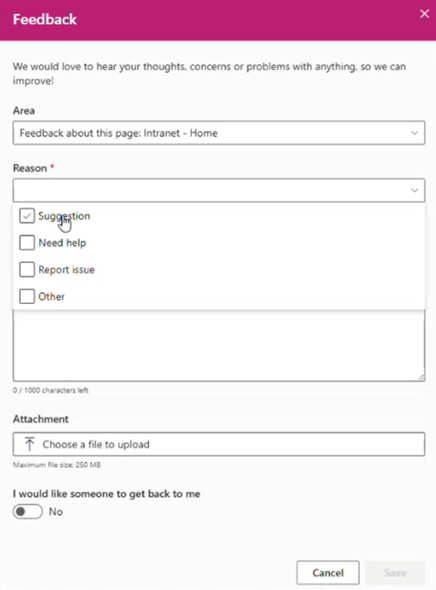
Feedback form in Fresh lets employees report issues or share intranet feedback from anywhere on the site.
How you handle violations matters as much as whether you handle them. Inconsistent responses, where some people face consequences and others don’t, create cynicism and resentment.
Document your processes. When something requires action, follow the same steps regardless of who’s involved. This protects both employees and the organization.
Some organizations moderate intranet content before it’s published. Others review after publication. Some do neither, relying on policies and reporting.
The right approach depends on your culture, your risk tolerance, and your resources. Pre-publication moderation catches problems early but slows communication and can feel heavy-handed. Post-publication review is lighter but requires quick response when issues arise.
If your intranet includes social features, discussion forums, or comment sections, the people managing those spaces need guidance. They should understand what crosses the line, how to intervene constructively, and when to escalate.
The structure of your intranet affects behavior. Open forums with anonymous posting invite different conduct than named comments on news articles. Spaces designed for debate will see more heated exchanges than spaces designed for information sharing.
Think about whether each feature serves its intended purpose. If a comment section consistently generates problems, maybe comments aren’t the right fit for that content type. If a discussion forum becomes toxic, consider whether moderation needs strengthening or whether the forum itself needs rethinking.
What works today may not work tomorrow. As your workforce changes, as social norms evolve, and as new challenges emerge, your approach to appropriate communications needs to evolve too.
Schedule periodic reviews of your policies and practices. Are they still fit for purpose? Are there new issues you didn’t anticipate? Are you striking the right balance between openness and oversight?
Here’s where it gets complicated. Your intranet is a company platform, which gives you significant rights to monitor its use. But employees have privacy expectations too, and laws in many jurisdictions protect certain communications.
Most jurisdictions allow employers to monitor communications on company systems, provided employees have been informed that monitoring may occur. This includes:
The key word is “informed.” Transparent policies that explain monitoring practices are both legally prudent and culturally healthier than covert surveillance.
Some areas require more caution:
Personal communications: Even on company systems, employees may have some privacy expectations for direct messages, particularly in jurisdictions with strong data protection laws. Review your legal obligations before implementing monitoring of private channels.
Protected discussions: In many places, employees have legal rights to discuss working conditions, compensation, or to organize collectively. Policies that prohibit these discussions, even on company platforms, may violate labor laws.
Medical or sensitive information: If employees share health information, family situations, or other sensitive personal details, that information may be subject to privacy protections even though it was shared on company systems.
Most organizations don’t read every intranet message. The goal is having the ability to investigate when concerns arise, not conducting constant surveillance.
Be transparent about your practices. If you tell employees that the intranet is monitored and inappropriate content will be addressed, you’ve set expectations appropriately. If you claim not to monitor but actually do, you’ve created a trust problem.
The best solution to inappropriate communications isn’t better monitoring. It’s a culture where people naturally communicate appropriately because they understand expectations and feel invested in maintaining a positive environment.
Lead by example: How leaders communicate on the intranet sets the tone. If executives are thoughtful and professional, it signals what’s expected.
Celebrate good examples: When employees share valuable content, recognize it. Positive reinforcement shapes behavior more effectively than punishment alone.
Address problems early: Small issues that go unaddressed become big problems. A quick, private conversation about a borderline comment prevents escalation.
Create value: If your intranet is genuinely useful and engaging, employees have more incentive to keep it that way. Platforms people care about get treated better than platforms people resent.
Every organization finds its own balance between openness and oversight. The right answer depends on your industry, your culture, your workforce, and your risk tolerance.
But the principles are consistent: set clear expectations, respond consistently when problems arise, respect privacy within appropriate bounds, and build a culture where heavy monitoring isn’t necessary.
Fresh helps by providing intranet platforms designed for professional communication, with the structure and governance features that support appropriate use without creating surveillance cultures.
Because the goal isn’t controlling what employees say. It’s creating spaces where they want to communicate well.
Get more from SharePoint search. Learn how to search effectively, configure it for better results, a...